Wednesday, October 26, 2011

Celeriac!


A vegetable that epitomizes the adage of "it's what's on the inside that counts," celery root (celeriac) may look gnarled and unappealing, but after stripping away its exterior there is something wonderful to be had. Celery root is closely related to celery but cultivated specifically for the root. Its uses date back to ancient times and it is even mentioned in Homer's Odyssey.

The flavor can be described as one of celery, parsley, with a twist of nuttiness.

In picking out celery root, look for roots that are firm and free of spots. As with any root, avoid ones that are soft or slimy as that indicates spoilage. Be prepared to lose about 1/4 of the root in preparation. To prepare, scrub and cut the skin off until there is no more brown. Celery root oxidizes quickly so you'll want to soak the peeled root in water with vinegar or lemon juice.

Celery root can be eaten raw or cooked. It can be grated or cut into thin strips and served as a salad with your choice of toppings. It also mashes perfectly with potatoes and lends itself particularly well to braising. Allow 10-15 minutes when boiling and 12-18 minutes to steaming it.

Tuesday, October 25, 2011

Jujube eatin' this?


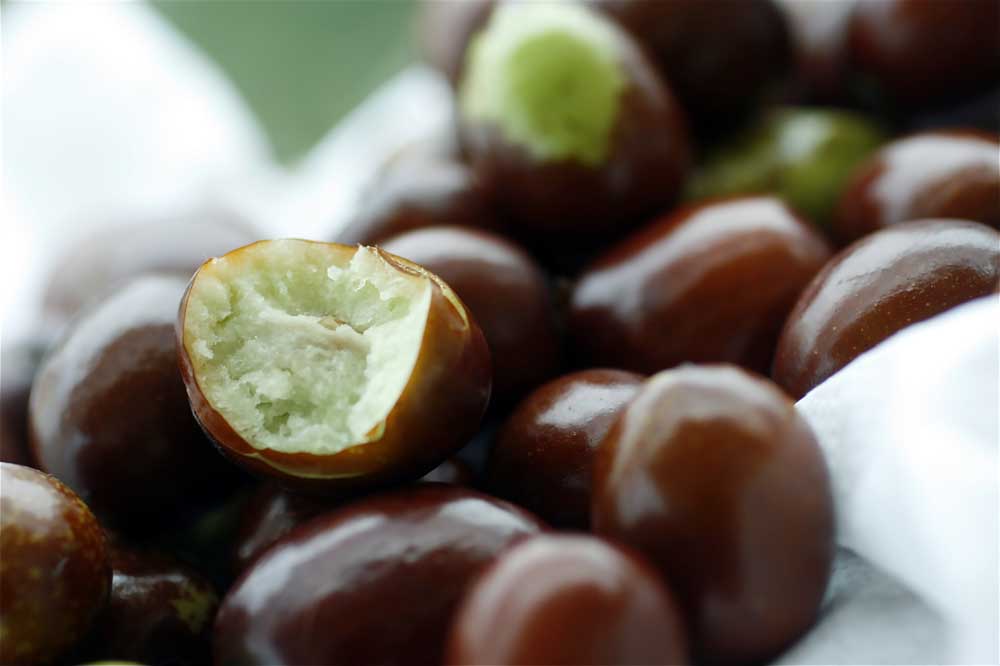
The Jujube, also known as the Chinese date, is a Fall fruit that has a mildly sweet taste and consistency similar to that of an apple although more airy. A ripe Jujube will be purplish-brown and eventually wrinkled, looking similar to a date. In the center of this fruit is a pit similar to the pit of an olive. This strange fruit is desired by many due to its high amount of Vitamin C which exceeds that of the citrus fruits. Jujubes are most commonly eaten as a snack, raw or candied. Many enjoy Jujubes with a cup of tea. In China Jujubes are sometimes used to make wine or vinegar.

Saturday, October 22, 2011

Spaghetti Squash


With Winter on the horizon, you may have noticed a wider variety of squash available. One of the more common and versatile squash to appear more prominently around this time is the Spaghetti Squash.

When selecting a Spaghetti Squash, find one that is heavy for its size and has an even pale color. Avoid ones with any soft spots and green coloring - as that is a sign of immaturity. An average four pound Spaghetti Squash should yield around five cups and every 4oz contains a mere 37 calories. There are many ways to cook one of these bad boys, but if you plan on cutting one in half make sure you have a large knife and some muscle power.

To prepare Spaghetti Squash whole, use a sharp knife to puncture it - much like a baked potato - and place it in the oven on 375 F for an hour. You can also boil, microwave, or slow cook it in a crock pot (if your crock pot is large enough.) One peculiar characteristic is that when cooked, this squash does not mash like other squash. The strands inside separate and are often used as a substitute for pasta. When your squash is cooked, cut it in half and remove the seeds and pulp and separate the strands by running a fork from stem to stern. The seeds can also be roasted similarly to Pumpkin seeds. To prepare the squash halved, you'll have to separate the pulp and seeds before cooking. Bake with the rind side up at 375 F for 30-40 minutes.

Thursday, October 20, 2011

Romanesco

     Romanesco is a cousin of broccoli, and has a flavor and texture somewhere right in between broccoli and cauliflower. Its vibrant lime green  florets are spiral shaped, made up of spines, each with a natural fractal-- each bud is composed of a series of smaller buds. It houses many nutrients like vitamin C, K, fiber and carotene. 
      As weird as it looks it is very simple to cook. Just think of something that you can make using broccoli or cauliflower and replace it with Romanesco. The differences stem more from texture than from taste. It has many flavor similarities to cauliflower, but in terms of texture it is softer and more suited to be used in crudites.  The flavor of Romanesco is similar to cauliflower, but is a bit creamier and nuttier with less of the traditional bitter characteristics found in most greens. Without this firmer texture it is able to be plated raw.

Monday, October 17, 2011

Delicata? I think you Oughta.


The Delicata squash, due to its taste and shape being similar to that of a sweet potato, is also known as the sweet potato squash. Although this squash is considered a winter squash and has a seasonality ranging from September to December, it belongs to the same family as the summer squashes. A ripe Delicata squash will have a cream color with orange spots and fading green stripes. The most common way of preparing a Delicata squash is by baking it, though it can also be steamed or sauteed. Delicatas are often served stuffed with a meat and veggie filling. The seeds of this squash can be toasted and eaten as well.

Saturday, October 15, 2011

I'm Thinking Hannah, Japanese

Pies, fries, casseroles...sweet potatoes can do a lot of things! Lots of traditional dishes exist in American cuisine for these tasty tubers, and plenty of other recipes can be made more exciting by a simple sweet substitution. While many dishes can come from the orange-fleshed variety, the lighter side of the spectrum is perfectly adept at handling a mess of meals. Here I'll talk about two distinct lighter-fleshed varieties: the Hannah and Japanese sweet potatoes.

While both are lower in moisture and sugar content than their yellow and orange fleshed cousins, there are still differences to account for. The Hannah sweet potato has a pale skin and a dry, crumbly texture. It is a great potato to make sweet potato pie, but it can also find itself at home as an adjunct to the more common russet, yellow, or white potato in salads and mashes. In comparison to other sweet potatoes, its lack of a tremendous sugar content or a particularly moist texture give it the most versatility of them all.

Japanese sweet potatoes share a little more in terms of fleshy characteristics with the oranger varieties. With a dark red to purple skin, the immediate presentation is strikingly similar to the garnet. This skin houses a starkly white interior, much like the Hannah, but the pale flesh of the Japanese sweet potato has a delicate sweetness and a distinctly nutty taste. The skin can be bitter, so it is best to remove it before eating. Steam or boil them to produce the best results (roasting can dry them out), and use them in a mash, au gratin, or even as sweet potato fries!

Thursday, October 13, 2011

Garnet and Jewel Sweet Potatoes

     Sweet potatoes come in many varieties and, in many cases, their flavor and appearance may overlap. In the case of the Garnet Sweet potato (often casually called "yam") their season peaks between September and March (which means we're stocking newly harvested ones right now!), but you would be hard pressed to find somewhere that did not stock them year round. Many sweet potatoes have a pale salmon color and are cylindrical in shape, tapering at the ends. The inside will be a deep, golden orange and starchy-- a bit like a potato.

      They are very healthy! The sweet potato is the root of a plant and holds most of the moisture and nutrition for the above-ground portion of the vegetable. This makes it an excellent alternative for potatoes when making fried or baked snacks such as French Fries or chips. Another way to prepare this variety of yam is boiling them until soft and mashing into a paste to be used in a pie. Of the common varieties, Garnets cook the quickest. Roast a few varieties at the same time, and Garnets will get soft and creamy first. These are the classic Thanksgiving sweet potatoes.


     Another variety available at Canyon Market is the Jewel sweet potato. It shares seasonality with the Garnet having its peak from September until March. Their skin is not quite as thick and they have a lighter orange with a pale orange hue. The flesh inside is bright orange and starchy but houses more moisture than the Garnet.

Monday, October 10, 2011

Sweet Potatoes: An Introduction


This week, we'll let you know about the four varieties of sweet potato we carry-- how they're different, how to pick them, and how to cook them!

The first question many people find themselves asking is, "What is the difference between a sweet potato and a yam?" The title of "sweet potato" and "yam" often get used interchangeably when in fact, they are far from being equals. A true yam is the tuber of a tropical vine and can grow to be 7-feet long and weigh 150 pounds. There are over 150 varieties and they are popular in Latin American and Caribbean markets. Yams contain more natural sugar content than sweet potatoes as well as a higher moisture content. Interestingly, uncooked yams are toxic but lose all their toxicity when cooked. If you can find a true yam (not very easy to do in this country!) .

Sweet potatoes on the other hand, are a little less daunting and toxin free. They come in two main varieties: pale and dark-skinned. A paler-skinned sweet potato has more of a yellow flesh which is less sweet and has a crumbly texture akin to a baking potato. The darker-skinned sweet potatoes (which are casually referred to as "yams" in U.S. markets) have a thick skin varying from an orange color to red. The flesh is a vibrant orange and tastes sweet and moist.

Check back later in the week as we get into the nitty-gritty of each sweet potato variety we carry!

Sunday, October 9, 2011

Persimmon Primer


Fuyu
The fuyu persimmon has a spicy-sweet flavor which resembles a blend of mango-papaya with a hint of apricot. A fuyu can be eaten raw like an apple or diced up and baked into bread or cake batters. Slightly green, premature fuyus can be sliced up, marinated in olive oil and cooked on a grill. A ripe fuyu should have reddish-orange skin, with no sign of green, and can be somewhat firm. The season of a fuyu ranges from October to late December.


Hachiya
The Hachiya persimmon, unlike the fuyu, is very soft when fully ripe. Hachiyas have a high content of tannins causing them to be very astringent if eaten before ripe. This persimmon is similar in taste to the fuyu but has a texture more similar to a thick jelly. Hachiyas, known as "the baking persimmon", can be pureed and used to make cakes, cookies, breads, pudding, and more. The season of the hachiya, like the fuyu, ranges from October to late December.